Trustfulness as a sin
Trustfulness as a sin is a recurring moral and existential question in Osamu Dazai's No Longer Human, crystallized after the violation of Yozo's wife Yoshiko. The concept interrogates whether absolute, uncritical trust—which Yozo had revered as a pure, almost sacred virtue—is itself a source of sin and suffering, rather than a safeguard against it. This inversion of conventional ethics becomes the central wound of Yozo's later life, driving him deeper into alcoholism, morphine addiction, and final despair.
The Virtue of Immaculate Trustfulness
Before the violation, Yozo regarded Yoshiko's trustfulness as a rare and precious quality, something he himself was utterly incapable of. He describes her as a "genius at trusting people," someone who "didn't know how to suspect anyone." For Yozo, whose ability to trust others is "so cracked and broken that I am wretchedly timid and am forever trying to read the expression on people's faces," Yoshiko's "immaculate trustfulness seemed clean and pure, like a waterfall among green leaves." This image of a pure cascade is the highest praise Yozo can offer; it represents a state of grace he can never attain. He had always imagined that the beauty of virginity was a sentimental illusion, but Yoshiko's trustfulness proved to him that it was "really alive and present in this world." This belief was so strong that it prompted his decision to marry her, a "then-and-there decision" to "steal the flower."
The Violation and the Birth of the Question
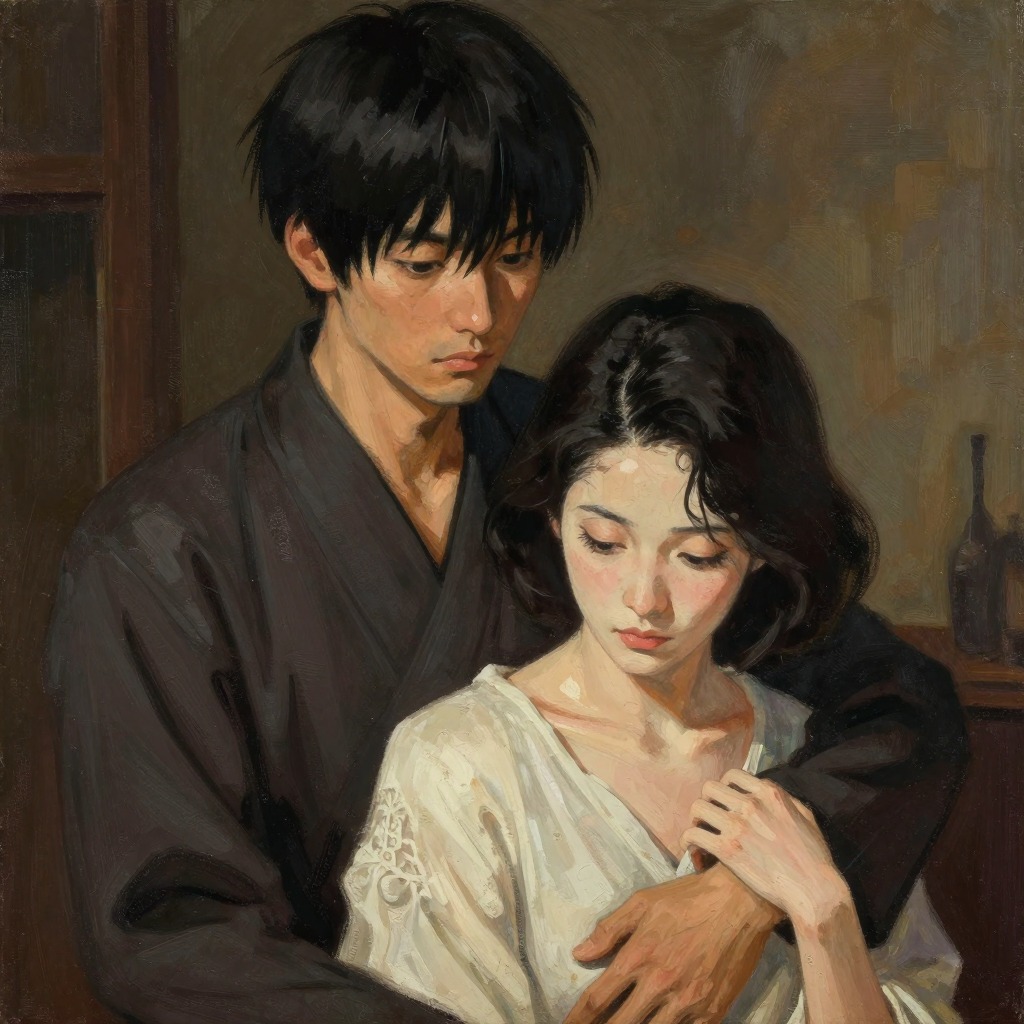
The event that transforms trustfulness from a virtue into a source of torment occurs one summer night when Yozo's friend Masao Horiki discovers Yoshiko with a shopkeeper in Yozo's own apartment. The shopkeeper, an illiterate, undersized man of about thirty who had commissioned cartoons from Yozo, had taken advantage of Yoshiko's inability to distrust. Yozo, watching from the stairs, does not intervene. He later reflects that the true tragedy was not the physical defilement of Yoshiko, but "the defilement of her trust in people." This defilement becomes "so persistent a source of grief as almost to render my life insupportable." The pure waterfall of her trust is turned "yellow and muddy" in a single night. From that night onward, Yoshiko begins to "fret over my every smile or frown," jumping when called and addressing Yozo with an excessive profusion of honorifics. The very quality that made her beautiful to Yozo is destroyed, and in its place comes a permanent anxiety.
The Unanswerable Question
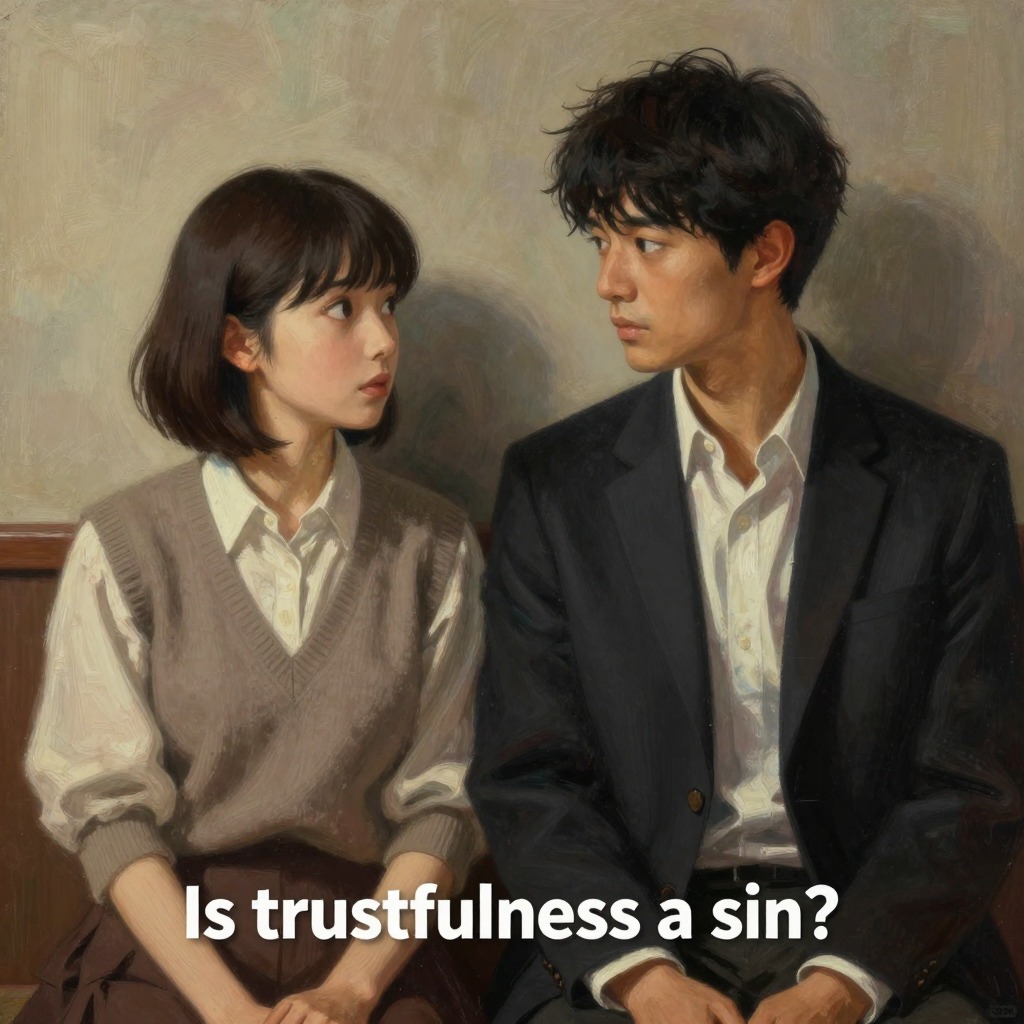
The narrative returns to the question "Is trustfulness a sin?" three times, each iteration more desperate. Yozo cannot find an answer in literature; he looks up novels in which married women are violated, but finds no instance of a woman violated in so lamentable a manner as Yoshiko. Her story, he concludes, "could never be made into a novel." The shopkeeper felt no love for Yoshiko; she was simply trusting, and that was all. The incident cleaves Yozo "between the eyebrows," turning his hair prematurely grey and making his voice hoarse. Unlike the husbands in the novels he reads, Yozo feels he has no right to forgive or not to forgive. He sees the entire event as his own fault: it was because of the rare virtue he prized—"the unbearably pitiful one called immaculate trustfulness"—that his wife was violated. The question becomes a direct address to God: "God, I ask you. Is trustfulness a sin?"
Consequences: The Collapse of Meaning
Once Yozo harbors doubts about the one virtue he depended on, he loses all comprehension of everything around him. His only resort is drink. His face coarsens, his teeth fall out from interminable drinking bouts, and his cartoons degenerate into pornography. He begins secretly peddling copies of pornographic pictures to buy gin. Doubt breeds fresh doubt: he wonders if Yoshiko yielded only that once, or if she had also been with Horiki or someone else. He lacks the courage to question her directly, instead writhing in his usual doubts and fears while drinking gin. The trustfulness that had been his last hope for a normal life—the dream of going on bicycles to see a waterfall framed in summer leaves—is shattered. The question "Is immaculate trustfulness a sin?" becomes the final nail in his coffin, leading directly to his second suicide attempt with an overdose of Dial sleeping pills and, eventually, his commitment to a mental hospital.
Thematic Significance: The Inversion of Ethics
The concept of trustfulness as a sin represents the ultimate inversion of conventional morality in No Longer Human. Yozo, who has spent his entire life deceiving others through clowning, finds that the one person who does not deceive him is destroyed by her own inability to deceive. The virtue he most admires becomes the instrument of his final undoing. This paradox echoes the novel's broader theme that the qualities which make one "human" in the eyes of society—trust, love, hope—are precisely the qualities that lead to the most profound suffering. Yozo's final state, in which he has "neither happiness nor unhappiness" and believes that "everything passes," is the direct result of this ethical collapse. The question "Is trustfulness a sin?" is never answered, but its very unanswerability is the point: for Yozo, the world is a place where even the purest virtue can be a source of damnation.